How to write a website tagline that says what you do in seconds
Visitors decide whether to stay on a website within roughly the first 10 seconds. Your tagline and intro text must therefore say clearly what the company does, who it is for and how it differs from competitors. Two simple tests and concrete words instead of empty phrases will help.

Why the first seconds matter
When someone opens your homepage, they do not read it from top to bottom. They scan it quickly, looking for the answer to one question: am I in the right place? If they do not find it within roughly 10 seconds, they close the tab and try the next search result.
That makes your tagline and the short text below it the most important words on the whole site. They need to say two things:
- what the company does, meaning what it sells or which service it provides,
- how it is different from others doing the same thing.
Why B2B makes it harder
Companies selling to other businesses often offer complex services or technical solutions. Describing them in one sentence is hard, so it is easy to slip into generic words like "innovative solutions", "comprehensive services" or "your partner for growth". They sound professional but tell visitors nothing. Almost any company could put that sentence on its website.
Test 1: Can you tell who is who?
- Write down your website's tagline and opening sentence.
- Add the taglines of your three strongest competitors.
- Remove all company and brand names.
- Try to match each text to its company. Even better, give the test to people outside your company.
If the texts are indistinguishable, your tagline does not say how you are different. A visitor comparing several websites sees it the same way.
Test 2: Rewrite the text as its opposite
Take your intro text and flip the meaning of its adjectives. A "robust and efficient solution" becomes an "unreliable and expensive solution". Would anyone ever write that about their own company? No. And that is exactly why the original sentence says nothing: it only claims what everyone claims about themselves.
A strong sentence passes this test. Its opposite makes sense because it describes a real choice, such as "for small businesses" versus "for large corporations".
Concrete beats abstract
A clear description of what you sell almost always beats a clever or abstract tagline. Compare:
| Weaker | Better |
|---|---|
| Innovating your company's future | Online accounting and payroll for small businesses |
| Quality you can trust | Emergency boiler repairs across the city |
| Your partner for digital growth | We build online stores for furniture makers |
The better versions use concrete verbs and nouns and say who the offer is for. These example sentences are made up and do not describe any real company.
How to structure the top of your homepage
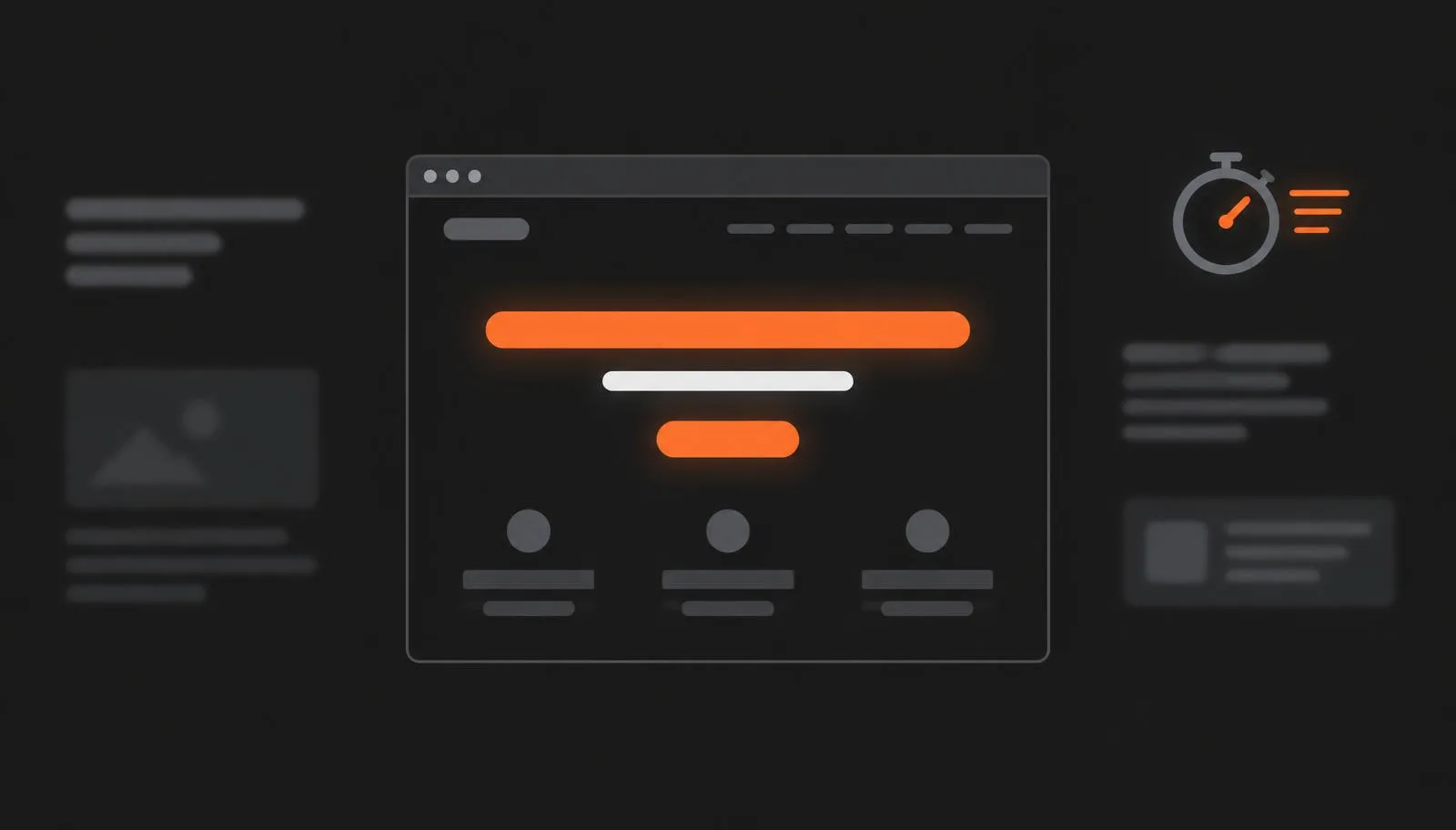
- H1 heading: what you do, simply and specifically.
- Subheading: who it is for and how you differ.
- Call to action: one clear button, such as "See pricing" or "Book a call".
Write the rest in short paragraphs with descriptive subheadings and bullet points. People scan websites; they do not read them word by word.
Your homepage as a trade show booth
Picture a trade show hall full of booths. People walk past and glance at each one for just a moment. They stop where they immediately understand what is on offer and whether it is for them. Lighting effects and animations will not hold attention if the message is unclear. A homepage works the same way.
Alignment with SEO and AI search
Your tagline and intro text should match the page title and meta description. When a search engine shows your result, people should find exactly what it promised after clicking. A concrete intro also helps AI search tools, which often summarise a website based on its first sentences. If those are generic, the summary will be generic too.
Checklist
- Does the tagline say what the company does?
- Is it clear who the offer is for?
- Is it obvious how you differ from competitors?
- Does the text pass the test without company names?
- Does the opposite of your sentence make sense?
- Does the intro have a heading, a subheading and one call to action?
- Does the intro match the page title and meta description?
Questions and answers
How long should a website tagline be?
Short enough to read at a glance. More important than length is that it clearly says what you do and for whom.
Is a clever or a concrete tagline better?
On a homepage, almost always a concrete one. Wit can work, but only if it is understandable without explanation.
How do I find out whether my tagline sets my company apart?
Show your tagline and your competitors' taglines without company names to people outside your company. If they cannot match who is who, your tagline does not differentiate you.
Does the tagline have to be the H1 heading?
No, but the H1 heading should clearly say what you do. It often works best when the tagline and the H1 are the same.
Does a tagline affect SEO?
Indirectly, yes. A concrete intro that matches the title and meta description helps both search engines and AI tools understand what the website is about.
If you need a website that says what you do from the first second, take a look at PeknéWeby.